
6463 is a surface-purity variant of 6063, not a stronger alloy. Buyers often ask us: then what are the actual mechanical numbers? And if 6463 is weaker, should we avoid it entirely? Here are the benchmarks we put on every Zenova technical data sheet.
T5 is a temper, not an alloy
T5 means the profile was air-quenched after extrusion and then artificially aged to a stable strength. T6 (water quenched) is stronger but more expensive to extrude and is essentially never needed for shower frames. Both 6063 and 6463 are commonly supplied in T5.
Mechanical property comparison (typical values)
| Property | 6063-T5 (typical) | 6463-T5 (typical) |
|---|---|---|
| Ultimate tensile strength (UTS) | 180 – 186 MPa | ~145 MPa |
| Yield strength (Rp0.2) | 140 – 145 MPa | ~110 MPa |
| Elongation at break | 12% | 8 – 12% |
| Brinell hardness | 60 – 75 HB | ~50 – 60 HB |
| Vickers hardness (converted) | ~70 HV | ~60 – 65 HV |
| Density | 2.70 g/cm³ | 2.70 g/cm³ |
Chinese national standard minimums (GB/T 5237.1)
For 6063-T5, the Chinese national standard requires:
- UTS ≥ 160 MPa
- Yield ≥ 110 MPa
- Elongation ≥ 8%
Reputable Zhongshan mills comfortably exceed these on both 6063-T5 and 6463-T5. A 6463-T5 frame will still pass every structural load test for a shower enclosure — it is simply not as stiff as 6063-T5, and the trade-off is worth it when the finish is mirror anodize. There is no one-to-one US equivalent; in North American purchase orders the same limits are usually written as a mill-certificate requirement.
What actually controls structural safety
For a non-load-bearing shower enclosure, the alloy grade is rarely the limiting factor. Wall thickness is.
- Minimum structural frame wall: ≥ 1.2 mm (≈ 0.047 in, industry baseline)
- Large-format or walk-in panels: specify 1.4 – 1.6 mm (≈ 0.055 – 0.063 in)
- Avoid hollow profiles below 1.2 mm; they feel rigid on the rack but deflect under glass weight after two years of use
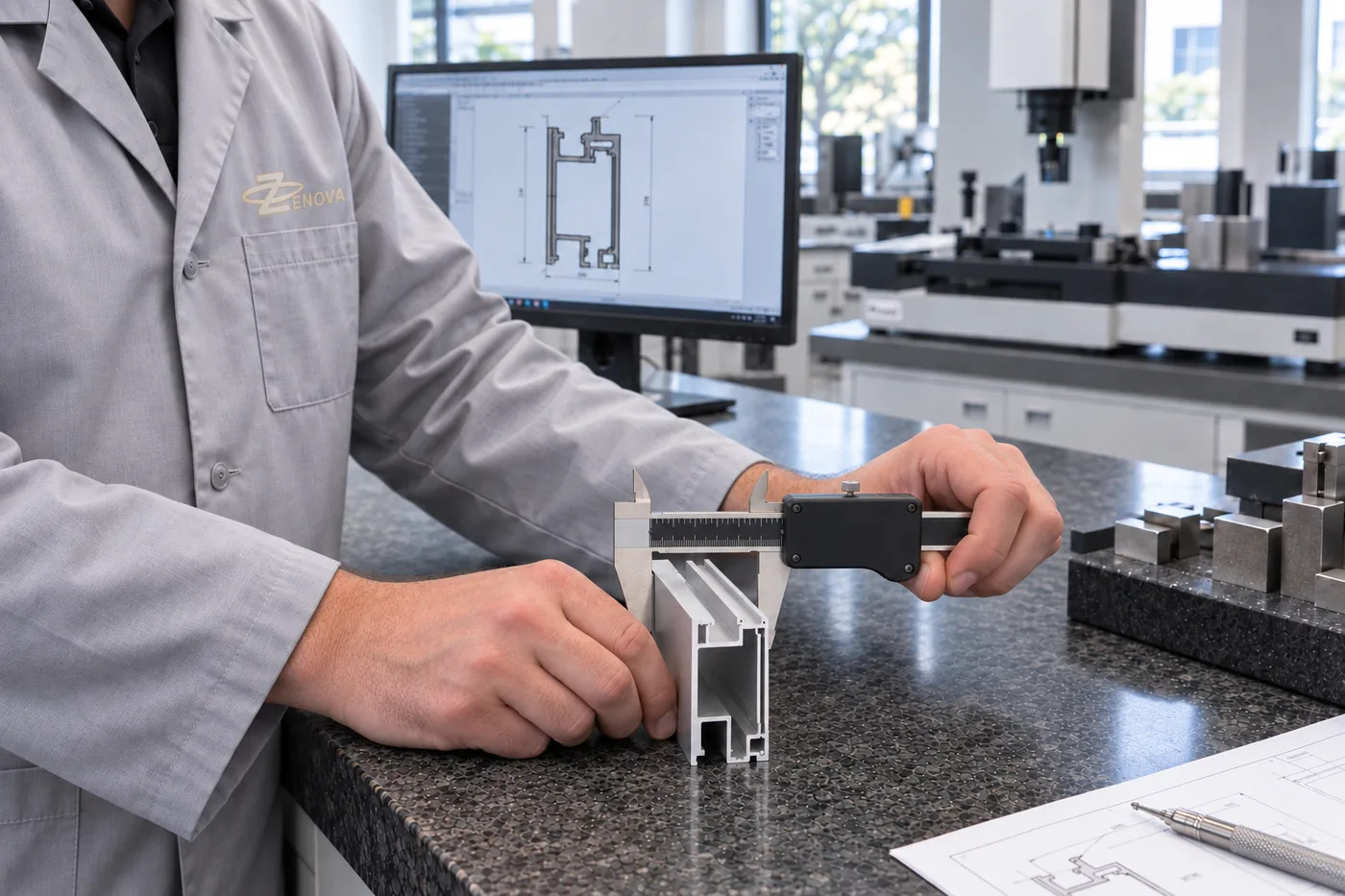
When you compare suppliers, ask for the cross-section drawing and a caliper measurement, not just the alloy number. A 1.2 mm 6063-T5 wall will outperform a 1.0 mm (≈ 0.039 in) 6463-T5 wall every single time.
Bottom line
Do not chase a higher alloy number. Specify 6063-T5 or 6463-T5 based on finish needs, then enforce wall thickness ≥ 1.2 mm and ask your extrusion supplier for a mill certificate showing UTS and yield on every batch. That is the engineering approach Zenova uses on its own export orders.
— The Zenova Engineering Team, Zhongshan, China