1. The Decision Starts at Project Acceptance
Selecting the surface finish on shower enclosure aluminum extrusions is never just a matter of "picking a color." For importers, procurement teams, and specifiers, it is an engineering decision that touches warranty, batch-to-batch consistency, on-site appearance, and long-term after-sales exposure. A single project may run from a few dozen sets to over a thousand, spanning the header, bottom rail, jamb, roller track, handle, and threshold — dozens of different profiles. Whether colors match across batches, whether they look right a few years later, and whether cleaning leaves marks should be answered by the finishing process itself, not discovered on site.
Across the mainstream routes — Type II anodizing, powder coating, electrophoretic deposition (e-coat), and the combined anodize-plus-e-coat process — Zenova's engineering position is specific: when the finish calls for a metallic, brushed, or dyed-anodized appearance, we choose anodizing over e-coat. Matte black and a narrow set of custom colors go to powder coating instead.
2. Where E-Coat Falls Short for Shower Enclosures
E-coat works by dipping the extrusion as an electrode in an acrylic or polyurethane bath, depositing a continuous organic film under current, then oven-curing. Its strengths are real — excellent edge coverage on complex profiles and salt spray performance beyond 1,000 hours. But for shower enclosure product lines, three boundaries are hard to work around.
First, its color space is narrow. E-coat is essentially a clear top coat with tinting paste. The colors it can produce reliably are limited to clear / natural, light champagne, light gold, clear bronze, and clear black. The colors that dominate the shower enclosure market — brushed nickel, brushed gold, gunmetal, chrome, dark bronze, brushed bronze — require metal dyeing on the porous anodic oxide layer before any top coat is applied. E-coat alone cannot reach them.
Second, dark and metallic colors show poor lot-to-lot reproducibility. E-coat tinting tolerance is tight; small shifts in bath concentration, cure temperature, or voltage curve all show up as visible color variation. With a dozen-plus profile parts per enclosure, a ΔE above 1.5 across batches reads as a mismatch on the installation wall.
Third, an organic film has a long-term aging ceiling. Even though e-coat typically achieves adhesion rating 0 (ASTM D3359), it is still an organic resin layer. After years in a hot, steamy bathroom with repeated exposure to mild acids and alkalis, a 5–8 year window can bring gloss loss and slight yellowing.
3. The Three Engineering Advantages of Anodizing
3.1 Film Hardness Matches High-Frequency, Long-Term Wear
A properly formed Type II anodic oxide film reaches 200–300 HV, on the same order as 304 stainless steel and well above the pencil hardness of an e-coat film (H to 2H). In a shower environment where the panel is wiped every day, that hardness is what keeps the finish looking fresh after years rather than months.
3.2 Metallic Texture Is Preserved, Not Smothered
The anodic oxide is itself a clear, transparent ceramic layer. The substrate below — brushed lines, satin sandblast texture, mirror polish — shows through in full. An e-coat adds a 10–20 μm (≈ 0.4 – 0.8 mil) organic film on top, which leans toward a uniform painted surface rather than a machined metal texture.
3.3 Wide Color Space and True Color-Match Capability
The porous layer of a Type II anodic film readily adsorbs organic dyes and inorganic pigments before sealing. Zenova's current anodized color program includes:
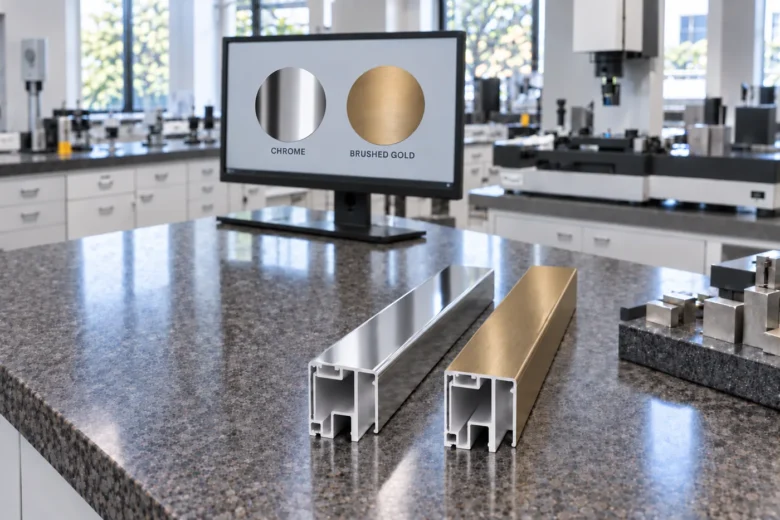
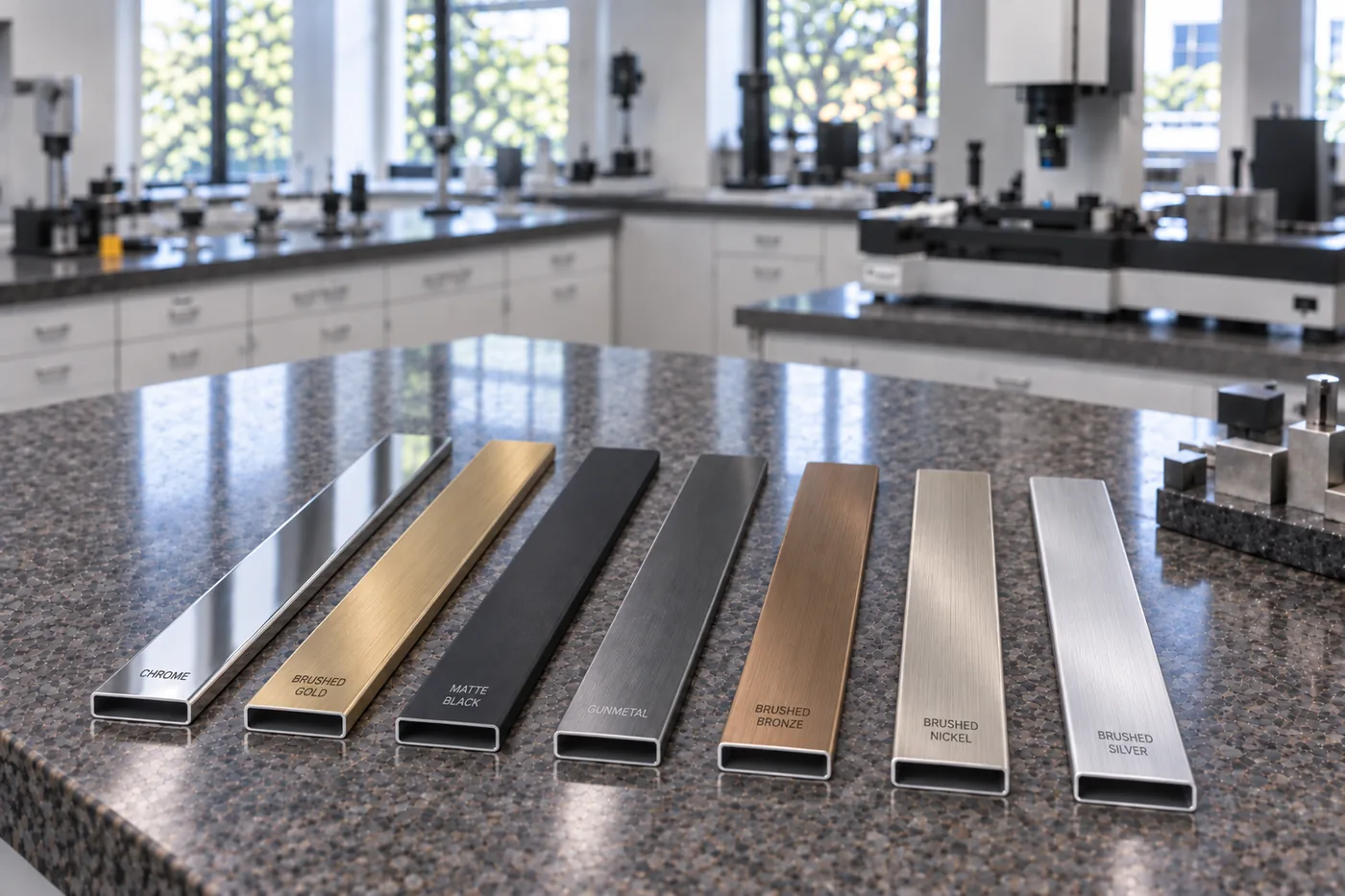
- Brushed finishes: brushed nickel, brushed gold, brushed silver, brushed bronze (240# brushed texture, 6–8 μm (≈ 0.24 – 0.31 mil) film)
- Bright finishes: chrome (thin film ~2 μm (≈ 0.08 mil), preserving mirror reflectivity)
- Metallic / dyed colors: gunmetal, champagne, bronze, gold
- Custom colors: color-matched to customer-supplied samples or Pantone references, typically sealed after 1–2 trial rounds
Matte black and a small set of aggressive custom colors are handled on our powder-coating line, where the required pigment load and deep saturation would compromise the anodize-and-seal process. Not every finish is a stock option — see Customization for the current range.
4. Bottom Line for Specifiers
- When the spec calls for a metallic, brushed, or dyed-anodized appearance, Zenova chooses anodizing over e-coat. The ceramic oxide is harder, the texture reads as machined metal, and the color window is wide enough for true custom matching.
- E-coat still has its place in purely clear/natural colors, exterior ultra-high-durability applications, and projects with no custom-color requirement — but it does not fit a shower enclosure program built around brushed metal finishes.
- Matte black and select custom colors are routed to powder coating, where the pigment load and saturation are controlled in a way anodizing cannot match, without the lot-to-lot risk of e-coat tinting.
— The Zenova Engineering Team, Zhongshan, China