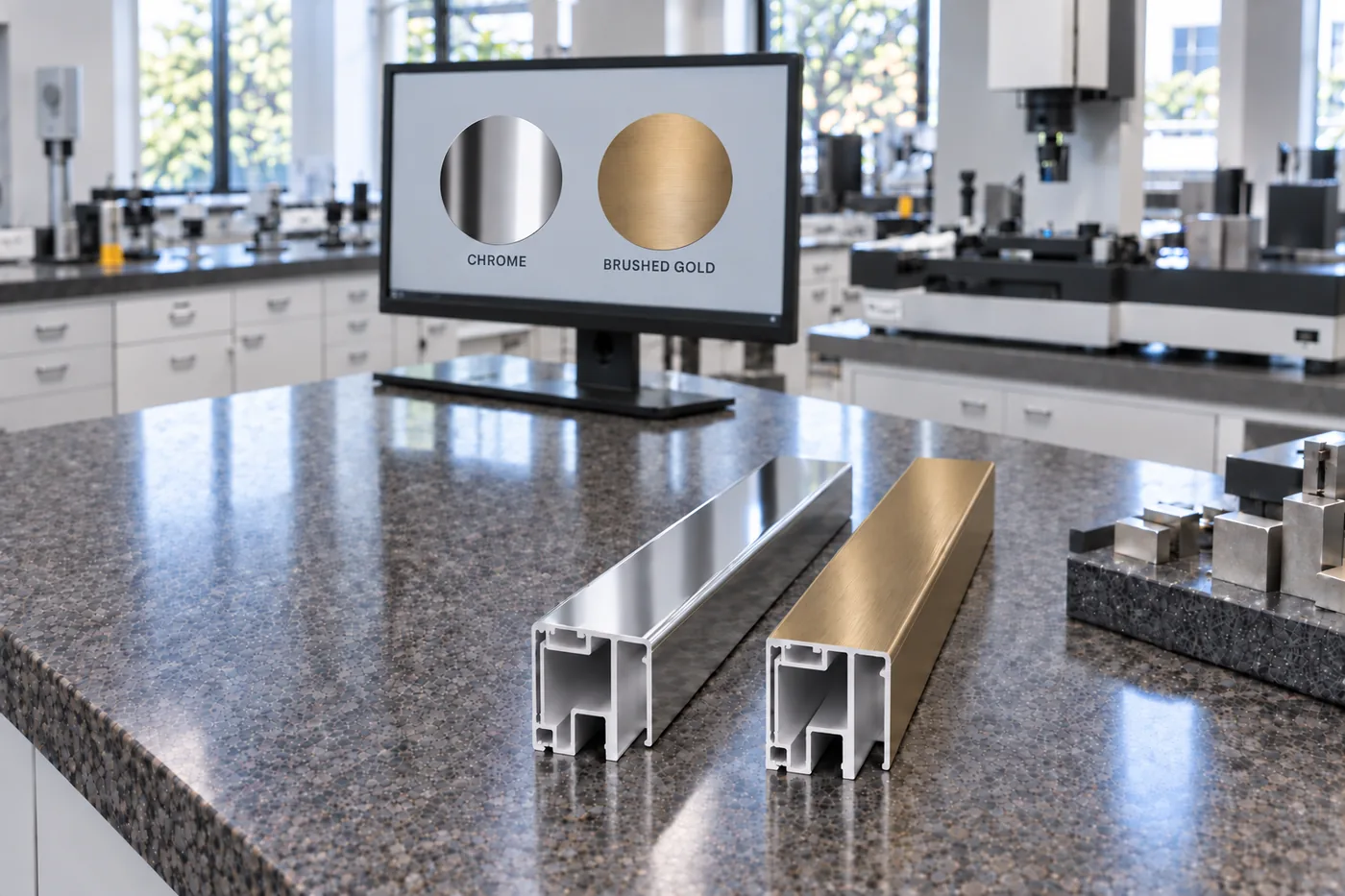
If you source shower enclosures from the Zhongshan / Foshan area in China, you will hear suppliers quote "6063-T5" almost as a reflex. Push for a chrome or mirror finish, and suddenly "6463-T5" appears on the spec sheet. Is 6463 a "stronger" alloy worth paying extra for? At Zenova, we tell our customers the truth: it is not about strength — it is about surface purity.
Same family, different mission
Both alloys are 6xxx series Al-Mg-Si extrusions, run on the same press lines. The composition overlap is large; the critical difference is iron content.
| Element | 6063 | 6463 |
|---|---|---|
| Si | 0.20 – 0.60% | 0.20 – 0.60% |
| Mg | 0.45 – 0.90% | 0.45 – 0.90% |
| Fe (impurity) | ≤ 0.35% | ≤ 0.15% |
| Total other impurities | looser control | ≤ 0.10% |
Iron in aluminum forms brittle intermetallic particles (FeAl₃, AlFeSi). During bright dip and mirror polishing, these particles dislodge or scatter light, leaving pitting, haze, and pinholes on the finished surface. By tightening Fe to ≤ 0.15%, 6463 can produce a near-stainless mirror anodize that 6063 simply cannot replicate at acceptable yield.
Which one should you spec?
Use 6063-T5 when:
- The frame is brushed, matte, satin, or powder-coated
Specify 6463-T5 when:
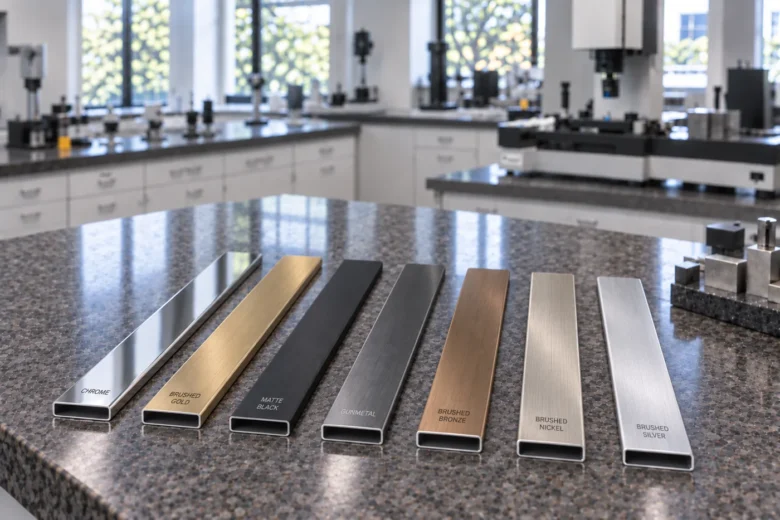
- You need polished chrome, mirror silver, bright champagne, or high-reflectance anodizing
- The design calls for visible, showroom-grade reflective surfaces
Do not pay a "premium alloy" upcharge for 6463 on a matte black powder-coated frame — the coating hides whatever alloy underneath, and you will never see the difference.
The honest takeaway
6463 is a cosmetic upgrade, not a structural one. The tensile and hardness numbers are covered in our guide on T5 mechanical properties (spoiler: 6063-T5 is slightly harder). What matters for shower frames is wall thickness and surface finish — not a higher alloy number on the drawing.
— The Zenova Engineering Team, Zhongshan, China