1. Laminated Glass in a Shower Enclosure: What "Safety" Actually Means
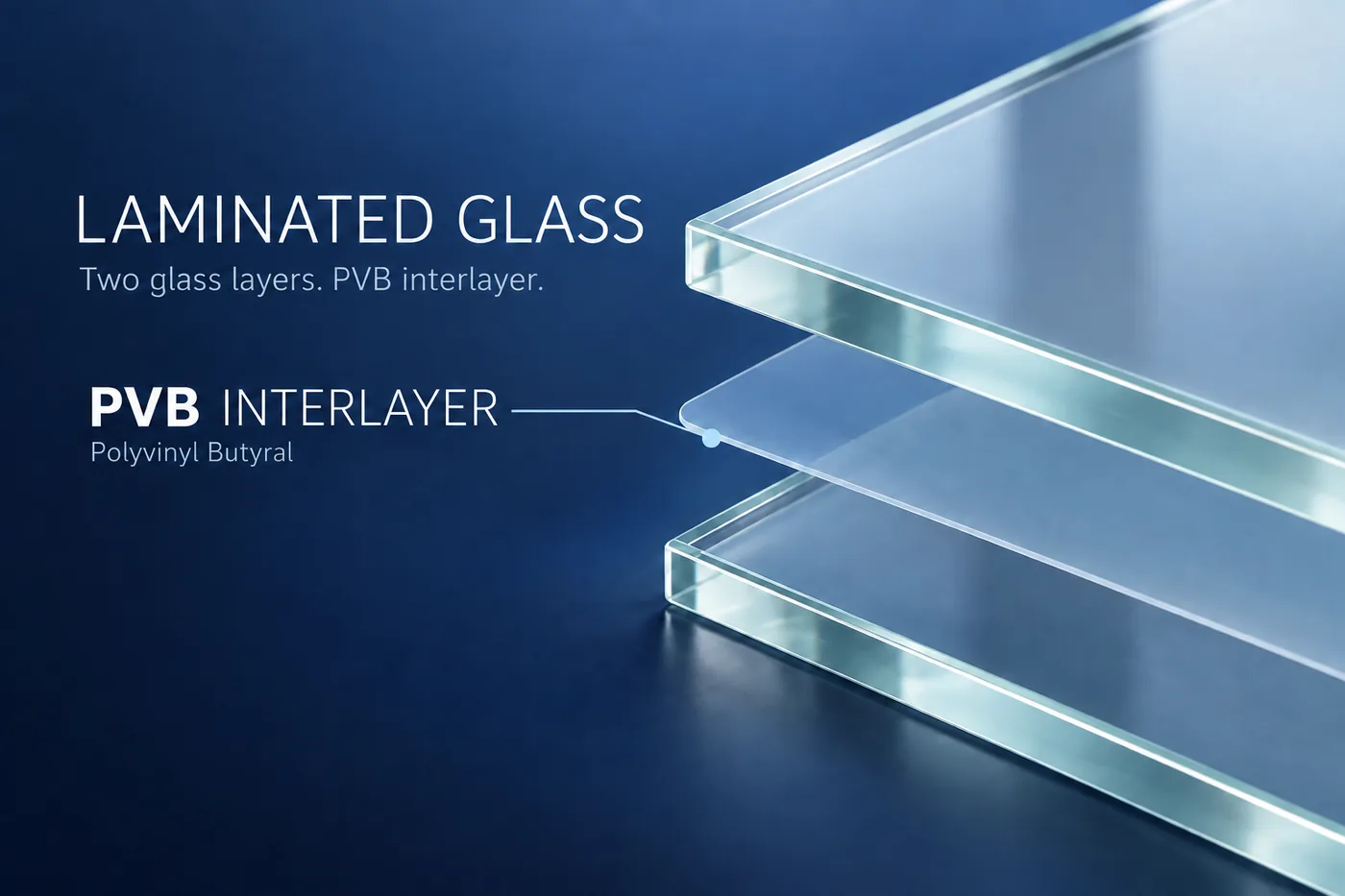
A modern shower enclosure has to satisfy two very different safety expectations at the same time. First, it has to be tempered glass — if broken, it crumbles into small, relatively blunt granules rather than sharp shards. Second, on any door or panel above a certain size, in any hospitality or multi-family project, and increasingly in premium residential spec sheets across North America, it has to be laminated — two plies of glass bonded to a plastic interlayer so that, if the glass does break, the fragments stay stuck to the film instead of falling onto the floor.
The interlayer is what does the second job. It is also where the industry splits: the two most common materials are PVB (polyvinyl butyral) and EVA (ethylene vinyl acetate). Both are clear polymer films, both are used in laminated glass, and both can technically pass a drop-ball impact test. But they are not equivalent in the way a North American shower enclosure specifier should expect.
At Zenova, every laminated panel we ship is built on a PVB interlayer, and the laminated glass comes from a manufacturer certified to ANSI Z97.1-2015 Class A, CPSC 16 CFR 1201 Category II and CAN/CGSB 12.1-2022 — see our Certifications page for the certificate holder and record number. This article explains why PVB is the right choice for North American shower enclosure programs.
2. What PVB Actually Is
PVB (polyvinyl butyral) has been the standard architectural and automotive interlayer for more than half a century. It is the material in every car windshield, in every skyscraper curtain wall, and in virtually every laminated guardrail and storefront across North America.
A PVB lamination is produced in an autoclave — a high-pressure vessel that heats the assembled glass-and-film pack to 120–130 °C under roughly 10–12 bar of pressure. The combined heat and pressure fully bonds the film to the glass, producing a void-free, optically stable laminate. This is a fundamentally different process from the low-temperature oven lamination used for EVA, and it is why PVB laminates are considered the reference standard in North American architectural glazing.
For shower enclosures, Zenova typically specifies:
- 4 mm (≈ 5/32 in) + 0.76 mm (30 mil) PVB + 4 mm for smaller panels and standard residential doors
- 6 mm (≈ 1/4 in) + 0.76 mm (30 mil) PVB + 6 mm for larger panels, hotel programs, and commercial applications
Both constructions fall within the range covered by the glass manufacturer's SGCC record: 4 + 4 mm to 6 + 6 mm with a 0.76 mm interlayer.
3. Five Engineering Reasons to Specify PVB
3.1 It Is the Interlayer North American Building Codes Actually Recognize
This is the most important point for a North American buyer, and it is rarely spelled out clearly.
The standards that govern safety glazing in the United States — ANSI Z97.1, CPSC 16 CFR 1201, and CAN/CGSB 12.1 in Canada — were written around, and have historically certified, PVB laminates. When an architect, a general contractor, or a building inspector asks "is this laminated glass code-compliant?", the answer they expect is tied to a PVB-based construction that has been through an autoclave and a third-party laboratory impact test.
EVA laminates, while used in interior decorative applications and in some regions of Asia, are not a default material in North American architectural glazing practice. Specifying EVA into a project that calls for "architectural laminated glass" can raise questions at plan review, at the building department, or during insurance underwriting. PVB carries no such ambiguity.
3.2 Adhesion Is Engineered for Fragment Retention
The whole purpose of laminated glass is what happens after breakage. Under a CPSC 16 CFR 1201 Cat. II impact, Class A performance requires that glass fragments remain adhered to the interlayer, and that the opening left behind does not allow a standard-size probe to pass through.
PVB achieves this through a combination of high tensile strength and controlled adhesion to the glass surface. When a PVB laminate breaks, the web of cracks stays largely in place; the panel does not collapse into a hole, and the sharp edges of the glass pieces remain bonded to the film rather than falling as free shards. This is the behavior that protects a bather against the very real scenario of tempered-glass spontaneous breakage in a hot, steamy environment.
EVA's adhesion is lower, and post-breakage fragments are more likely to slide or drop out of the film. For a high-traffic hotel bathroom or a multi-family corridor, that difference matters.
3.3 Optical Clarity and Long-Term Appearance
PVB is an optical-grade material. A properly autoclaved PVB laminate shows:
- Uniform transparency with no haze or "orange peel" across the panel
- No bubbles, inclusions, or waviness at the edges
- Consistent color transmission across the entire sheet
- No yellowing under normal interior conditions over a 10+ year service life
In a shower enclosure, the customer looks through this glass every day. A cloudy edge, a trapped dust speck, or a faint yellow tint is immediately visible and reads as a quality defect. The autoclave process that PVB requires is precisely what delivers the optical consistency that North American buyers expect from architectural glass.
3.4 Noise Reduction Is a Real, Specifiable Benefit
PVB is a viscoelastic polymer. It does not just hold glass plies together — it dampens vibration between them. In a North American master bathroom, where the shower sits two feet from a freestanding tub, a toilet, and sometimes a bedroom wall, the acoustic difference between a single pane and a PVB-laminated pane is measurable. PVB attenuates mid-range transmission (speech-level noise) more effectively than an equivalent monolithic or EVA laminate, which is why it is also the material of choice for recording studios, urban condominium glazing, and airport terminals.
This is not a marketing point we lead with in every project, but it is a real performance advantage for open-concept bathrooms and attached master suites.
3.5 99% UV Block Protects the Bathroom Itself
PVB blocks approximately 99% of ultraviolet transmission through the glass. In a shower area, that matters less for the bather (there is little direct sun) and more for the finishes around it: natural stone vanities, wood cabinets, fabric shower curtains, and brass or chrome fixtures near a bathroom window all age more slowly behind a PVB laminate than they would behind unlaminated glass.
This is a benefit architects and interior designers increasingly recognize, and it is a specification argument that carries weight in premium residential and hospitality programs.
4. Addressing the Moisture Question Honestly
In the lamination industry, PVB is correctly described as more hygroscopic than EVA. An unprotected PVB edge left standing in open water for years can develop the so-called "cloudy border" effect. This is a real limitation of PVB, and it is worth stating honestly.
In a shower enclosure, however, the edge is not exposed to open water. It is captured inside an aluminum extrusion, against a rubber seal, and covered by a cap or a finished jamb. The edges that Zenova ships are:
- Cut and seamed on automated glass processing lines
- Washed, dried, and assembled in a controlled clean room before autoclaving
- Sealed at the factory where the lamination is performed
- Installed into a closed aluminum frame with a continuous EPDM or silicone gasket
Under that construction, the PVB interlayer never sees standing water. The hygroscopicity issue that affects open-edge architectural installations simply does not apply to a framed shower enclosure panel. The Zenova production process is designed around this.
For the rare unframed or minimally framed configuration — a ceiling-length fixed panel with a polished exposed edge — Zenova applies a secondary edge seal (butyl or polysulfide) at the factory. This is the same edge-sealing practice used on structural PVB installations in curtain walls.
5. The Zenova PVB Specification, Stated Plain
For every Zenova shower enclosure that ships with laminated glass:
- Interlayer: PVB (polyvinyl butyral), 0.76 mm (30 mil) nominal
- Construction: typically 4+4 or 6+6, tempered
- Process: autoclave lamination, not oven lamination
- Certification: covered by the glass manufacturer's SGCC record, tested to ANSI Z97.1-2015 Class A, CPSC 16 CFR 1201 Category II and CAN/CGSB 12.1-2022
- UV protection: ~99% UV block
- Edge condition: factory-sealed; secondary edge seal available on request for exposed edges
- Documentation: the glass manufacturer's SGCC record is published on our Certifications page; if your project needs further documentation, list it in your quote request so we can confirm what is available for your order.
6. Bottom Line for North American Buyers
- PVB is the interlayer North American building codes and inspectors recognize. It is the material behind automotive windshields and architectural curtain walls. It is not an exotic or premium upgrade — it is the reference standard.
- Safety performance is engineered, not incidental. Autoclave lamination delivers consistent adhesion, fragment retention, and optical clarity that oven-laminated alternatives cannot match at the same quality level.
- The moisture limitation of PVB is real but irrelevant inside a framed shower enclosure, where the interlayer edge is protected by aluminum, seals, and gaskets.
- An SGCC record is the proof on paper. A record number that can be checked with the certification body, and the third-party test behind it, are what general contractors, building departments, and insurance underwriters actually accept.
If you are specifying a North American shower enclosure program and comparing laminated options, ask three questions of any supplier: Which interlayer material is used? Is the glass autoclave-laminated? Can you show the SGCC record number for the glass, and name the laboratory that tested it?
— The Zenova Engineering Team, Zhongshan, China