
1. The Glass Question Buyers Ask Most Often
Among the technical questions Zenova receives on export inquiries, glass material ranks just behind hardware and aluminum profiles. And within glass, the single most common question is not "tempered or heat-soaked" — it is: "Are you using ultra-clear glass?"
Behind that question is an industry-wide shorthand that has hardened into a myth: ultra-clear means premium, standard clear means entry-level. The reality is more nuance than that. Both are fully compliant architectural tempered glasses. The difference is not "good versus bad" — it is a difference in iron content that drives visual and performance trade-offs. This article spells out what ultra-clear (low-iron) glass actually changes, and when paying the premium is justified versus when standard clear is the more sensible specification.
2. The Core Difference: Iron Content
Standard clear float glass and ultra-clear float glass are the same soda-lime-silica product made by the same process. The only meaningful chemical difference is iron oxide (Fe₂O₃) content:
| Parameter | Standard Clear Glass | Ultra-Clear (Low-Iron) Glass |
|---|---|---|
| Fe₂O₃ content | ~0.10% | ≤ 0.015% (roughly 1/10) |
| Visible light transmittance (4 mm ≈ 5/32 in) | 83–89% | 91–92% |
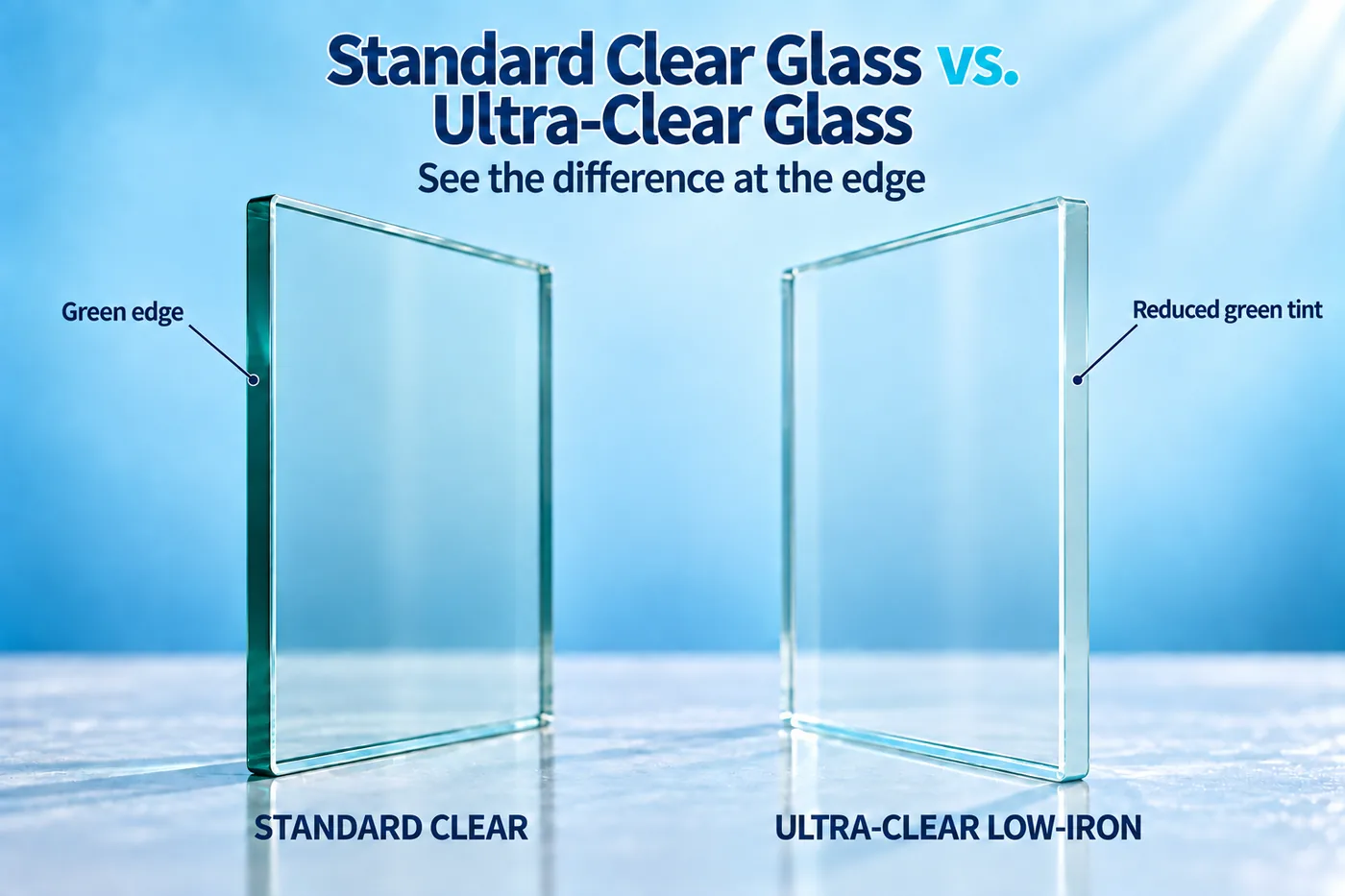
| Edge appearance | Noticeably green, deeper with thickness | Pale blue (industry "azure edge"; ) |
| Color rendition through glass | Yellow-green cast, slightly darkened | True color, neutral |
| Post-tempering spontaneous breakage rate | ~0.3–0.5% | < 0.1% |
| Raw glass cost | Baseline | ~15–25% premium |
Every visual and performance difference below traces back to that single order-of-magnitude shift in iron content.
3. What Actually Changes Beyond Light Transmission
3.1 Edge Color — The First Thing the Eye Picks Up
Iron impurities in standard clear glass absorb shorter visible wavelengths, which is why the cut edge of standard clear glass reads distinctly green. At the 8 mm (≈ 5/16 in) thickness typical of shower enclosures, that green edge is especially pronounced — the panel reads as a "green glass" rather than a "clear glass" from across the room.
Ultra-clear glass, with iron an order of magnitude lower, shows a pale blue cut edge — what the industry calls the azure edge, and what North American buyers know as the Starphire® look on thick panels. Against white, cream, or light-gray tile, standard clear will subtly tint the surrounding finish green; ultra-clear does not.
This matters most for frameless or minimalist enclosures, where the glass edge is fully exposed and the green tint is visible immediately.
3.2 True Color Rendition Behind the Glass
Behind a shower panel you often find marble, natural stone, colored tile, and premium hardware. Looking through standard clear glass, those finishes read as yellowish-green and slightly muted. Looking through ultra-clear, the colors come through as specified.
In hospitality and premium residential programs, the gray stone, blue mosaic, or matte-black hardware selected by the designer should not change hue because of the panel in front of it. This is the single reason ultra-clear is the default specification on high-end projects.
3.3 Lower Spontaneous Breakage After Tempering
Standard clear glass carries more impurities in the raw batch. Nickel sulfide (NiS) inclusions are the leading cause of tempered-glass spontaneous breakage. Ultra-clear glass, with its purer raw materials and tighter melt control, brings the post-tempering spontaneous breakage rate down from the industry-typical 0.3–0.5% to below 0.1%.
It is important to be precise here: ultra-clear is not the same as "never breaks on its own." Every piece of tempered glass carries some residual risk. The responsible specification still calls for a Heat Soak Test (HST). Ultra-clear simply starts from a cleaner baseline; it does not replace HST.
3.4 Perceptual Spaciousness in Smaller Bathrooms
Standard clear glass, with its green cast and slight darkening, visually pushes the room inward by a shade. Ultra-clear, with its neutral transmission, lets the wet and dry zones read as one space rather than two. In a compact master bath or a US-style "powder room plus" layout, that perceived openness is real. It is also why frameless shower programs in North America almost default to low-iron glass.
3.5 Water Spot Visibility — Stated Honestly
Suppliers often market ultra-clear as "resists water spots and stays cleaner." That is an oversimplification. The surface chemistry of ultra-clear and standard clear is essentially identical — both will spot. The difference is visual contrast: because ultra-clear itself is neutral, water spots read less harshly against it than against a green-tinted panel. The same scale of spotting looks less obvious on ultra-clear and more obvious on standard clear. It is a perception difference, not a cleaner-surface difference. Normal cleaning is still required.
4. Selection Guidance
| Project Type | Recommended Glass |
|---|---|
| Domestic value-engineered projects, deep-toned bathrooms | Standard clear 8 mm tempered — best value, performance more than adequate |
| Mid-range export residential programs | Standard clear 8 mm tempered, add HST where specified |
| Frameless / minimalist / hospitality / premium residential | Ultra-clear 8 mm tempered — visual and finish upgrade |
| Light stone, white / light-gray tile backgrounds | Ultra-clear — avoid the green edge affecting the finish |
| Buyers who explicitly require "no green tint" | Ultra-clear |
| Coastal, high-humidity, commercial washrooms | Either clear or ultra-clear; the critical variables are hardware grade and sealing |
5. Bottom Line
- Ultra-clear and standard clear are both compliant tempered architectural glasses. The difference is iron content, not a quality grade.
- Ultra-clear's real advantages: neutral edge color, true color rendition, lower baseline spontaneous breakage, perceived spaciousness in smaller rooms.
- Standard clear's real advantages: 15–25% lower cost, mature supply chain, performance fully adequate for ordinary residential use.
- The selection rule: light/white natural stone, frameless and minimalist builds, premium hospitality and residential programs → specify ultra-clear. Dark finishes, budget-sensitive projects, standard residential work → standard clear is sufficient.
If you are running a supplier comparison, the practical on-site test is simple: look at the tile behind the glass. If it is white, cream, or light gray, standard clear will read green. If the tile is dark, the green edge will not be visible and the premium is hard to justify. Ask your supplier for both samples side by side on the actual project tile before committing.
— The Zenova Engineering Team, Zhongshan, China