
1. The Color Question on Stainless Hardware
Brushed stainless steel in a shower looks clean and premium — until a project asks for gold, champagne or gunmetal. Then a decisive question appears: how do you color stainless steel without losing what makes it stainless?
Traditional answers each fall short. Paint or e-coat covers the metal in an organic film — it chips, it scratches, and in a metallic color it reads as plastic. Conventional water electroplating can deposit a colored layer, but it offers a narrower range of metallic shades that is harder to hold from batch to batch, and it produces process wastewater. Neither meets the visual standard of a machined metal part.
PVD — physical vapor deposition — is the finishing route Zenova specifies for colored stainless hardware. It is the same technology family used on watch cases, faucets, and premium door hardware, and it answers the four requirements that matter most in a shower enclosure: easy color matching, higher wear resistance, high metallic luster, and a dense, chemically stable film that adds a barrier on top of the stainless steel's own corrosion resistance.
2. What PVD Actually Does
PVD takes place inside a vacuum chamber. A solid target material — typically a metal or alloy such as titanium, chromium, or zirconium — is vaporized by arc or sputtering, then deposits atom by atom onto the stainless part as a thin, dense film. A thin chromium or titanium base layer goes down first so the color layer bonds to the steel. By introducing reactive gases (nitrogen, oxygen, or acetylene) and controlling their ratios, the film's chemistry changes — and so does its color.
Color is a function of film composition, not of pigment mixed into a paint batch — for example, TiN-based films for gold tones, ZrN-based films for champagne and light bronze tones, and carbon-containing films such as TiCN for darker gunmetal tones. That is the foundation of everything that follows.
A note on matte black: matte black hardware is not finished by PVD. It is powder-coated on the same 304 base — the one color where an organic finish is the right tool, because it gives the deep, even matte surface that a thin metallic film does not. For a dark metallic look, deep black PVD is available as a made-to-order finish — see PVD Finishes.
3. Four Engineering Reasons Zenova Specifies PVD
3.1 Easy, Repeatable Color Matching
PVD color is set by process parameters: target material, gas flow, deposition time, and temperature. Once a parameter set is locked, the color is highly repeatable from batch to batch — far more so than painted or e-coated finishes, where pigment dispersion and cure conditions drift. This matters for shower hardware because a single enclosure carries multiple parts — handle, hinges, clamps and fittings — and they must all read as the same color on the glass. Zenova color-matches to customer samples or Pantone references, locks the parameter file for repeat orders, and a reorder a year later matches the first shipment.
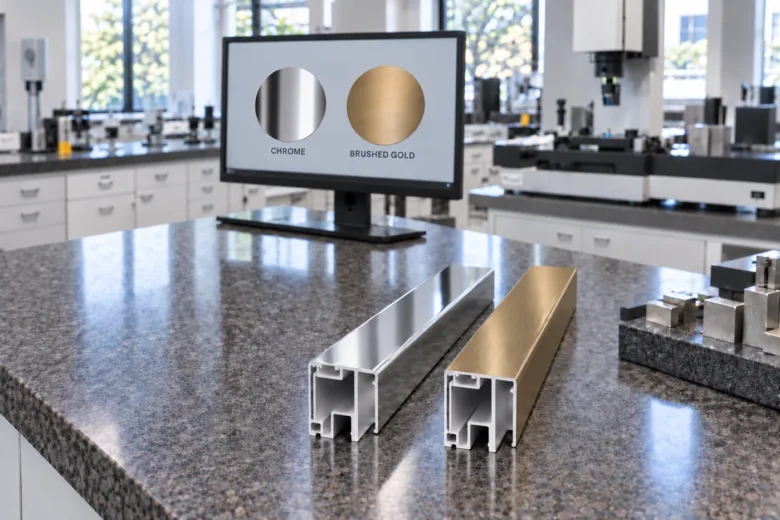
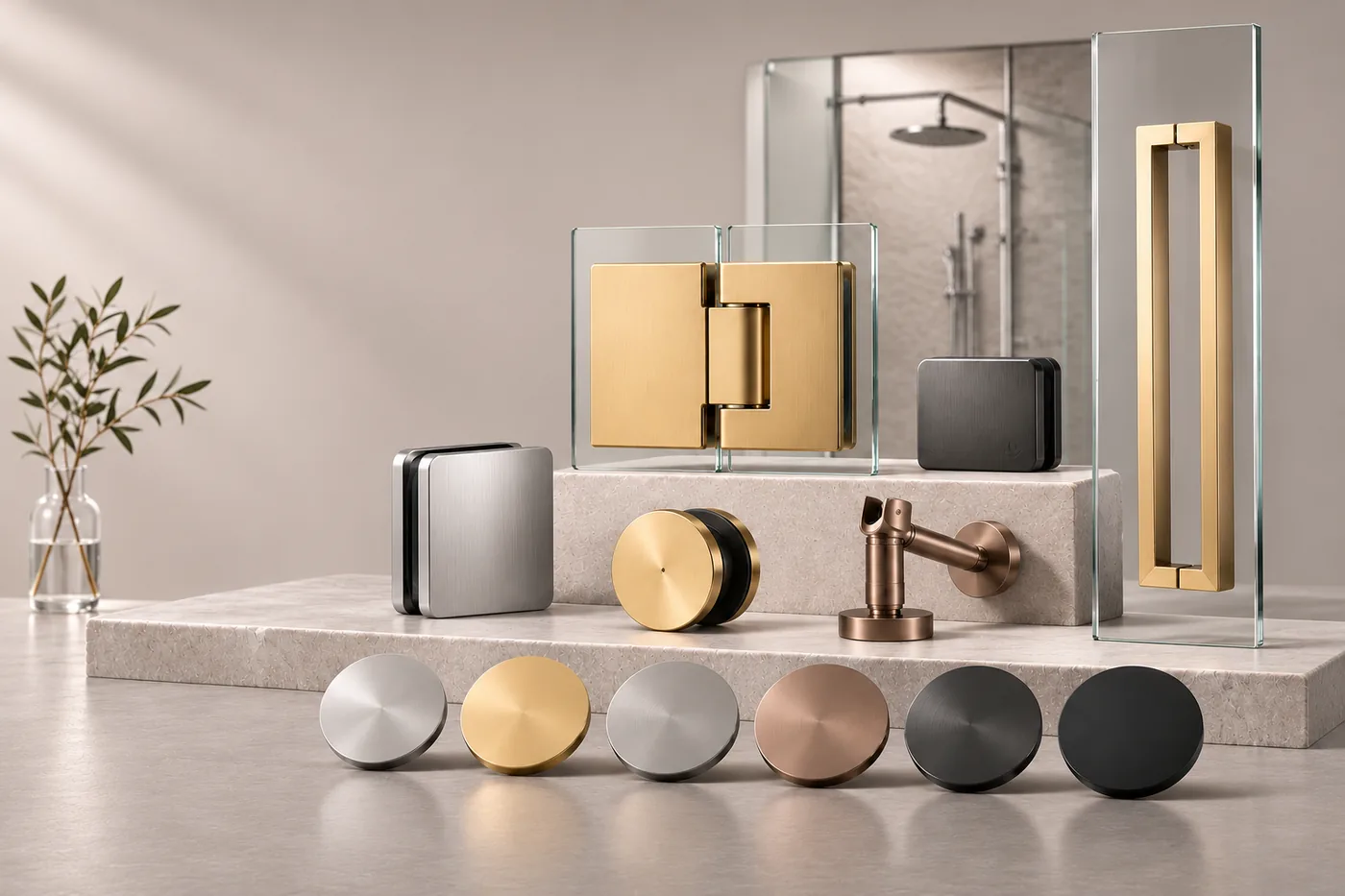
Zenova's standard PVD colors: brushed gold, brushed champagne, and gunmetal. Brushed bronze, and custom color-matching to a customer sample or Pantone reference, are available on request. Brushed nickel and chrome need no coating at all: on stainless hardware they are the 304 itself — brushed to a satin finish for brushed nickel, polished to a mirror finish for chrome.
3.2 Higher Wear Resistance
A PVD film is a hard, ceramic-like coating — not a soft paint. Film microhardness typically runs 2,000–3,000 HV, two to three times that of decorative chrome plating and far above any organic coating. In daily use the handle is gripped with wet, soapy hands, and the hinge moves through thousands of cycles. PVD films resist abrasion, scratching, and repeated wiping, which is why PVD has become the standard finish for colored faucets and premium door hardware.
3.3 High Metallic Luster
Because PVD deposits a dense, thin film rather than a pigment layer, the finish keeps the metal's natural reflection. A gunmetal or brushed gold PVD handle still reads as metal — you see the brushed texture through the color. Painted and e-coated parts look flat by comparison. In a frameless shower, where hardware sits on the glass in direct view, that metallic depth is exactly the premium look buyers pay for.
3.4 Corrosion Resistance — A Barrier on Top of 304, Not a Substitute for It
The PVD film is chemically stable and adds a dense barrier over the polished stainless surface. But the film is thin, so long-term corrosion performance still starts with the base metal: a colored part is only as good as the 304 or 316 underneath it. That is why Zenova specifies the substrate first and the color second:
- Standard PVD on 304: the right choice for residential and most commercial bathrooms.
- Premium multi-layer PVD: a denser multi-layer stack with tighter process control, recommended for coastal, hotel, and pool-side projects. It extends corrosion protection without changing the color.
Salt-spray performance is agreed per project in the purchase contract, not quoted as a catalog number. The test method is neutral salt spray (ASTM B117); B117 defines how the test is run, not how many hours a part must pass, so the hours are always a contract figure. On coastal or hotel projects where the base material is stepped up to 316 (see Article 5), the same PVD colors hold and the premium multi-layer option is the default.
4. The Zenova PVD Specification
| Item | Zenova Specification |
|---|---|
| Base material | 304 stainless steel (standard; Cr 18–20%, Ni 8–10.5%); 201/202 never used; 316 upgrade (Mo 2–3%) for coastal / hotel / pool |
| Surface texture | Polished before coating: brushed / satin / mirror |
| Coating | PVD (TiN / ZrN / TiCN families), film thickness 0.2–2 μm (about 0.008–0.08 mil); matte black excluded — see below |
| Standard PVD colors | Brushed gold, brushed champagne, gunmetal. Brushed bronze on request. Custom color-matching to customer sample or Pantone reference |
| Matte black finish | Powder-coated on the same 304 / 316 base (not PVD) |
| Brushed nickel and chrome finishes | 304 / 316 brushed to a satin finish (brushed nickel) or polished to a mirror finish (chrome), no coating |
| Corrosion resistance | Standard PVD on 304; premium multi-layer PVD recommended for coastal / hotel / pool; 316 substrate upgrade on request. Neutral salt-spray (ASTM B117) hours agreed per project in the purchase contract |
| Wear resistance | Film microhardness 2,000–3,000 HV |
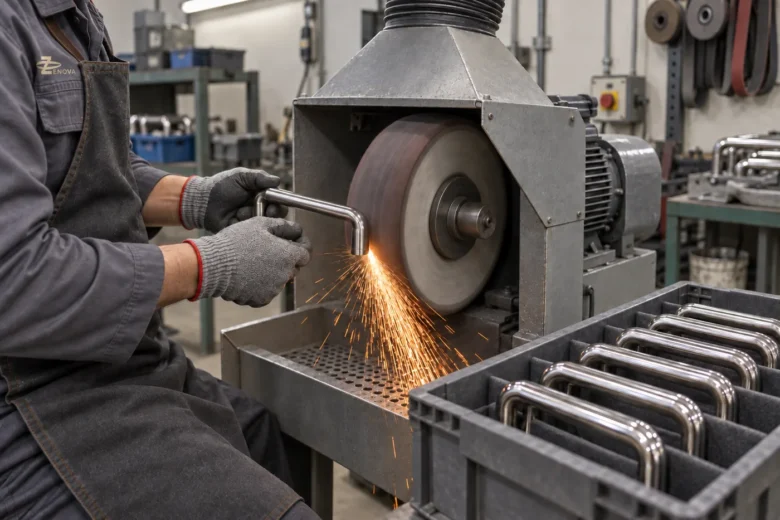
| Process sequence | Polish → clean → base layer (chromium or titanium) → PVD color layer → QC |
5. Bottom Line for Buyers
Colored stainless hardware is a finishing decision, and the finish defines both the look and the service life.
PVD gives you color that is easy to match and repeat, a hard surface that stands up to daily wear, a true metallic luster, and a dense barrier on top of a 304 or 316 base. For coastal and hotel projects, specify premium multi-layer PVD and agree the salt-spray hours in the contract.
Ask any supplier three questions: What is the base grade — 304 or 201? Which finish is on which color — PVD for the colored tones, brushing or polishing with no coating for brushed nickel and chrome, powder coating only for matte black? And what salt-spray hours will they write into the contract for the finished color?
— The Zenova Engineering Team, Zhongshan, China