
1. Why the Hinge Matters
The hinge is the only moving part on a hinged glass shower door. It carries the door's full weight, absorbs every closing impact, and decides whether the door lands quietly, stays closed, or drifts open. For importers and distributors selling into North American residential markets, hinge choice drives three things you cannot fix after installation: door drop, water leakage complaints, and warranty cost. This guide covers the hinge types actually used on shower doors, wall-mount configurations, door weight and width rules, opening angle limits, cycle-life benchmarks, and the Zenova specification position.
2. Hinge Types Used on Shower Doors
We leave out the hold-open (90°) hinge here — it is rarely used on shower doors. The three types that matter are:
| Type | How it closes | Typical use |
|---|---|---|
| Single-acting self-closing | Spring pulls door shut from the outside; opens one direction only. | Residential hinged doors that open one way. |
| Double-acting self-closing | Spring pulls door shut from either side; opens both inward and outward. | Frameless hinged doors that swing both ways, European-style enclosures, high-traffic bathrooms. |
| Hydraulic soft-close | Spring plus hydraulic damper slows the last 10–15° of travel. | Premium enclosures, hotel projects, quiet-close expectations. |

Key clarification: "Self-closing" means the door returns to the closed position on its own. "Soft-close" is a separate hydraulic feature added on top — it does not replace the spring. A hydraulic hinge is a self-closing hinge with a damper cartridge inside.
Wall-mount configurations (spring hinges)
Beyond the closing function, spring hinges are also split by how they fix to the wall or wall profile:
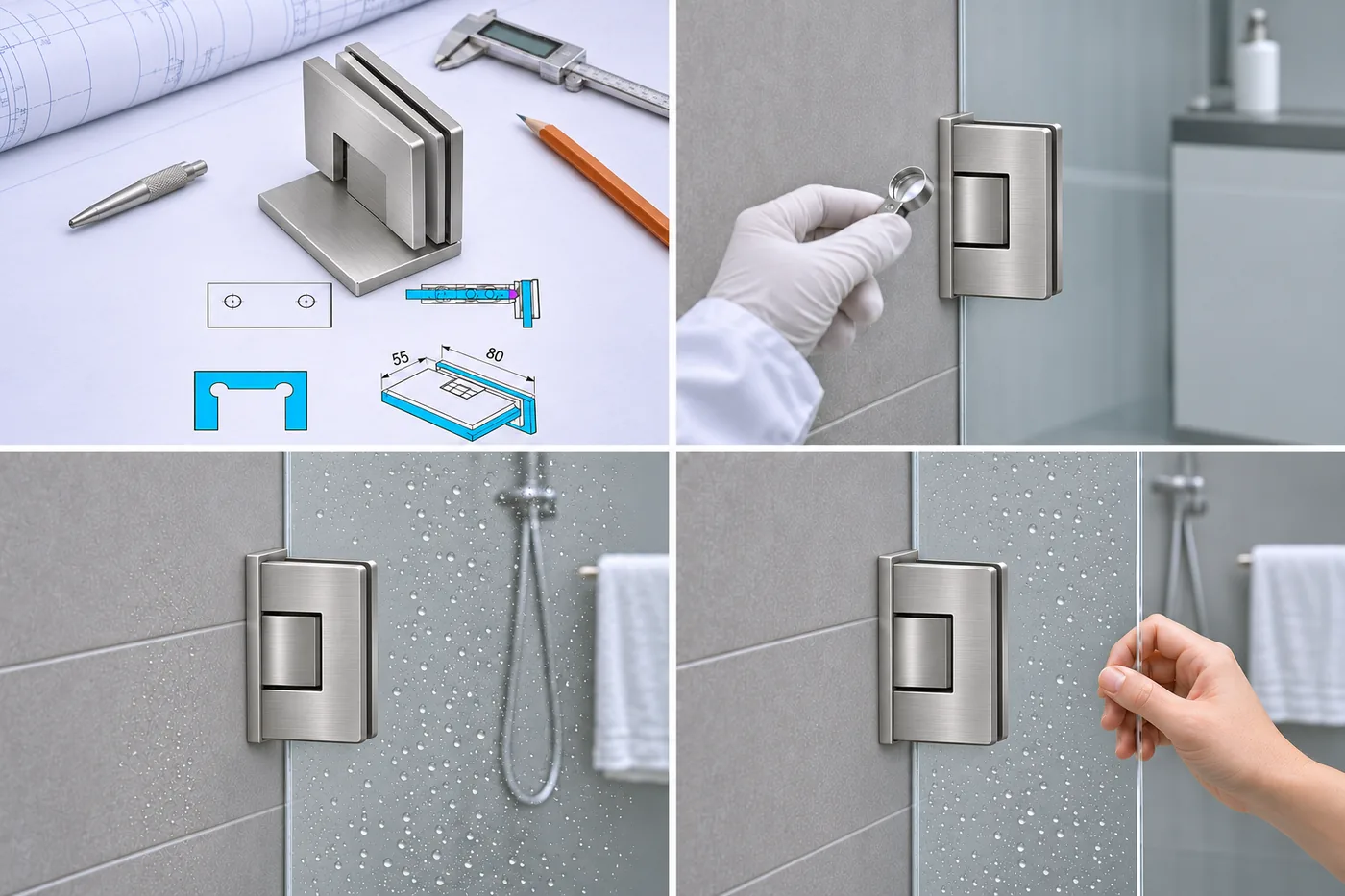
- Two-sided screw fixing (double-face mounting): screw holes appear on both the glass-side and wall-side faces of the hinge body. More rigid, higher load rating, recommended for wider and heavier doors.
- One-sided screw fixing (single-face mounting): screw holes on one face only. Cleaner front face, slimmer profile, saves installation depth, preferred for narrow wall returns and minimalist enclosures.
Zenova position: both mounting configurations are available with hidden screw covers — the fixing holes are concealed under a press-on cover plate in either case, so the visible front face stays a clean, screw-free finish regardless of mounting type.

3. Pros and Cons of Spring Self-Closing Hinges
Advantages
- Simple mechanical design — one spring, one pin, few failure points.
- Low cost — typically 30–50% of a hydraulic hinge at retail.
- Works in cold climates — no oil viscosity to thicken in winter.
- No leak path — no hydraulic oil, so no seal failure risk over time.
- Lighter hardware — easier for installers to handle and mount on-site.
Disadvantages
- Closes with a mechanical thud — no dampening on heavier or wider doors.
- Closing force fades over time — spring tension drops gradually with use.
- Sensitive to installation tolerance — off-square glass or wall misalignment accelerates wear.
- Cannot hold the door open at 90° — unless an additional hold-open feature is added.
- Noise on heavy doors — a 10+ mm glass door can slam if undersized.
- Requires magnetic seal or strike plate to land softly — the spring itself does not soften the last inch.
4. How to Calculate Door Weight
Use this formula before picking a hinge: Door weight (kg) = Width (m) × Height (m) × Glass thickness (mm) × 2.5. Quick reference for standard tempered glass: 8 mm ≈ 20 kg/m²; 10 mm ≈ 25 kg/m²; 12 mm ≈ 30 kg/m².
Example: an 800 mm × 2000 mm door in 8 mm glass = 0.8 × 2.0 × 8 × 2.5 = 32 kg.
5. Door Weight and Width Rules
| Door width | 8 mm glass | 10 mm glass | Hinges |
|---|---|---|---|
| 700 mm | 28 kg | 35 kg | 2 |
| 800 mm | 32 kg | 40 kg | 2 |
| 900 mm | 36 kg | 45 kg | 2 |
| 1000 mm | 40 kg | 50 kg | 3 |
Zenova rule: up to 900 mm door width, two hinges; above 900 mm, add a third hinge. The table shows static door weight at a 2000 mm door height, from the formula in Section 4.
6. Opening Angle Limits
- Single-acting spring hinge: typically 90° opening (good units allow 100–110°). Cannot fold flat against the wall.
- Double-acting spring hinge: ±90° each way; self-pulls closed starting at 20–25° from the closed position.
- Hydraulic soft-close hinge: mechanically limited to 90–100°; commercial dampers rated to ≤120°. The damper cartridge cannot fold flat.
Premium hinges offer an adjustable zero position so the door lands exactly on the magnetic seal.
7. Cycle Life and Failure Points
Standards and industry data:
- QB/T 2584-2023 is the current Chinese industry standard for shower enclosures.
- Industry reference (not Zenova test data): standard spring hinges ~50,000 cycles; hydraulic dampers 100,000+ cycles.
- Manufacturers' data sheets: CRL Bellagio — 50 kg door, 1000 mm maximum width, 8–10 mm glass; Bohle Juna — 50 kg per pair.
Failure modes
- Spring hinge: spring tension weakens gradually with use; pin wear causes play.
- Hydraulic hinge: damper oil seal leaks after extended cycling; once it leaks, the whole unit must be replaced — you cannot top up oil.
8. Spring vs Hydraulic Soft-Close
| Dimension | Spring self-closing | Hydraulic soft-close |
|---|---|---|
| Closing feel | Mechanical thud | Soft, controlled last 10–15° |
| Cost | Lower | Higher (~2–3×) |
| Cold climate | No issue | Oil thickens below ~5 °C, slow-close complaints |
| Failure mode | Spring weakens over time | Seal leaks, whole unit replaced |
| Industry reference cycles | ~50,000 | 100,000+ |
| Best fit | Volume residential, warm climates | Premium, hotel, quiet-close expectation |
Cold-climate caution: hydraulic damper oil thickens in the cold, so closing slows down in bathrooms that get cold. Be cautious specifying hydraulic hinges for those projects.
9. Installation Tolerance (Zenova Internal Control Values)
These are our internal control values, not code requirements:
| Check | Requirement |
|---|---|
| Door verticality | ≤2 mm/m (on a 1.9 m door, top-bottom offset ≤~3.8 mm) |
| Pivot coaxiality | ≤0.2 mm between hinge pivot centers |
| Hinge-to-glass gap | A 2 mm silicone pad fully fills the clamp channel — no gap between pad and glass |
| Clamping torque | 3–5 N·m preset torque; never tighten by feel |
| Acceptance | Play ≤0.5 mm; noise ≤45 dB at 1 m; operating force 15–25 N |
10. Zenova Specification Guidance
- Standard configuration on Zenova HT frameless hinged doors: AISI 304 double-acting self-closing hinge + magnetic seal. We never use 201 stainless (see Article 5). This is the volume configuration: durable, affordable, with light after-sales.
- Zenova HP doors use standard (non-self-closing) hinges that open one way — outward or inward, specified at order. North American residential code requires hinged shower doors to open outward, so order HP doors with outward-opening hinges for this market.
- Mounting choice: both two-sided and one-sided screw fixings are available; two-sided for wider and heavier doors, one-sided for slim and minimalist enclosures.
- Hidden screws: both mounting types are offered with a press-on cover plate — the visible front face is screw-free in either case.
- Hydraulic soft-close: available as single-acting self-closing only — premium option, never standard across the line. Higher cost and whole-unit replacement do not support a volume rollout.

- Cold-climate caution: be cautious specifying hydraulic hinges for bathrooms that get cold; winter slow-close complaints are likely.
- No lifetime promise: hydraulic dampers wear with use. Never promise "lifetime soft-close"; plan for replacement instead.
— The Zenova Engineering Team, Zhongshan, China